When will Thailand start issuing Apostilles?
Thailand deposited its instrument of accession with the depositary on 30 June 2026 (Cabinet approval 9 December 2025). Per the HCCH, the 1961 Convention enters into force for Thailand on 28 February 2027; until that date the Department of Consular Affairs, Ministry of Foreign Affairs (Legalisation Division) cannot issue an Apostille and Thai documents still use the legalisation chain (MFA certification, then the destination embassy in Bangkok).
Who is the competent authority for a Thai Apostille?
Only the Department of Consular Affairs, Ministry of Foreign Affairs (Legalisation Division) may issue an Apostille on a Thai public document. No law firm, notary or translation agency can issue one — an agent can only prepare, translate and file the document on your behalf.
Which countries still require embassy legalisation instead?
Non-member states are unaffected by the Convention and still need the older legalisation chain (MFA certification, then the destination embassy in Bangkok). The most common examples for Thai documents are mainland China (Hong Kong and Macao are covered separately), the UAE, Saudi Arabia, Qatar, Kuwait, Oman, Bahrain, Egypt, Vietnam, Cambodia, Laos and Myanmar. Check the HCCH status table before you assume an Apostille will be accepted.
Does my Thai document need a translation before the Apostille?
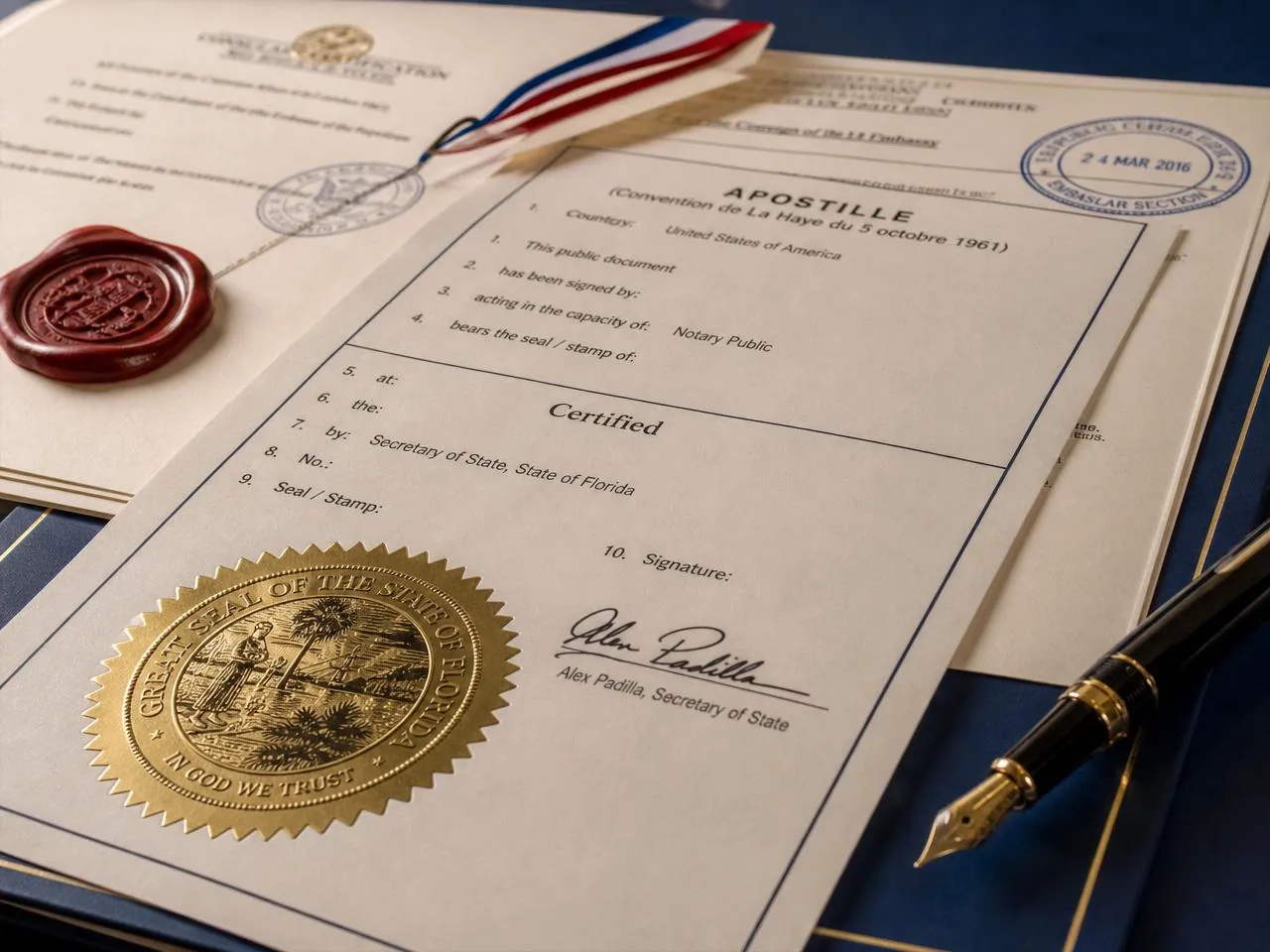
It depends on the receiving authority, not on the MFA. An Apostille only authenticates the signature, seal and capacity of the Thai official who signed the document — it says nothing about the content or the language. Most destination authorities want an English (or local-language) translation attached, so we normally certify the translation first and Apostille the bundle together.
How long does the process take?
At the Department of Consular Affairs, standard service is normally 2 working days and express service 1 working day per document. Academic records that must first be verified by the Ministry of Higher Education, Science, Research and Innovation add roughly 3–5 working days before the file can be lodged.
I have a foreign document with an Apostille — is it usable in Thailand?
Not yet on the Convention basis. Until the Convention enters into force for Thailand on 28 February 2027, a foreign Apostille alone is not sufficient: the document still needs legalisation by the Thai embassy or consulate in the issuing country. Thai offices will also require a Thai translation certified by a translator on the Ministry of Justice list, which we arrange in Bangkok.
Can an Apostille expire?
The Apostille itself has no expiry date. What expires is the underlying document: many Thai registries and immigration offices will only accept a civil-status extract or a police clearance issued within the last 3 to 6 months, so plan the filing close to your submission date.
Do I have to be in Thailand?
No. With a signed power of attorney we collect the original from a Thai registry or from your representative, handle certified translation, lodge the file at the Department of Consular Affairs and courier the Apostilled bundle to your address abroad.