Power of attorney
Selling property abroad, operating a foreign bank account, or authorising a relative to act for you in another jurisdiction.
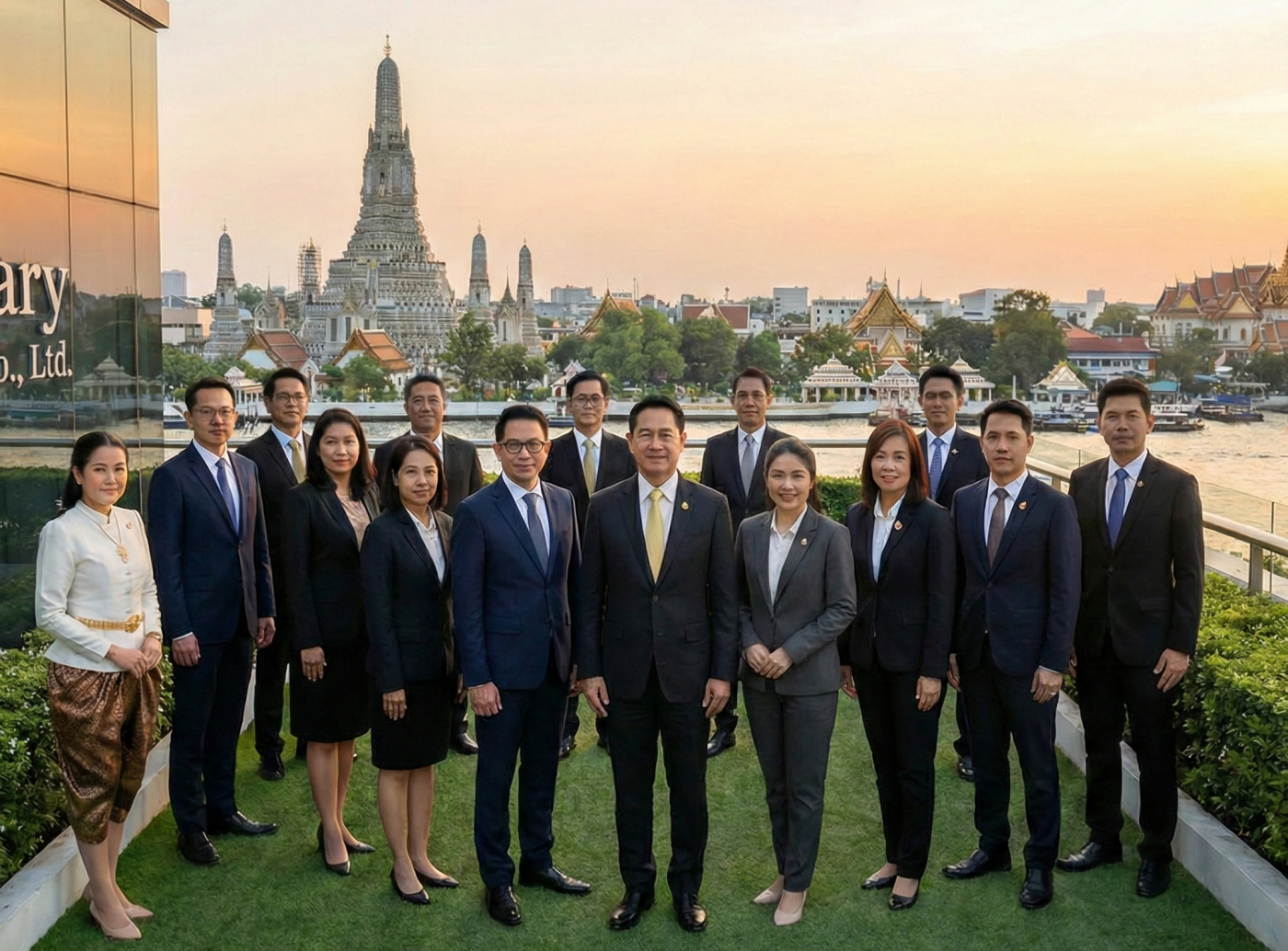
ทีมทนาย Notary Public ของเรา
ทุกการรับรองดำเนินการโดยทนายความผู้ขึ้นทะเบียนเป็น 'ทนายความผู้ทำคำรับรองลายมือชื่อและเอกสาร' กับสภาทนายความในพระบรมราชูปถัมภ์ คลิกที่ใบอนุญาตเพื่อดูฉบับเต็ม
Thailand certifies practising lawyers as Notarial Services Attorneys rather than appointing notaries public. We witness your signature, certify copies and administer affidavits in Bangkok, then carry the file through Apostille or embassy legalisation when the receiving authority requires it.
A Thai "notary public" is formally a Notarial Services Attorney: a lawyer licensed by the Lawyers Council of Thailand to witness signatures, certify copies and administer affidavits. Foreign authorities accept the attorney's seal and Council registration number, and can require a further Apostille or embassy legalisation on top of it.
Selling property abroad, operating a foreign bank account, or authorising a relative to act for you in another jurisdiction.
Single status, income, identity or parental consent declarations required by a foreign registry or court.
Passport, degree certificate, company documents — certified against the original for submission to a foreign authority.
Board resolutions, share transfers, director signatures and subsidiary incorporations for a parent company overseas.
Sponsor letters, financial support declarations and consent to travel for a minor.
Banks and brokers abroad that require a witnessed signature before they act on instructions from Thailand.
Not in the common-law sense. Thailand has no separate notary profession; instead, the Lawyers Council of Thailand certifies practising lawyers as Notarial Services Attorneys under the Lawyers Act B.E. 2528 (1985) and the Council's notarial services regulation. A certified attorney's signature and seal are what foreign authorities accept as 'notarisation' of a Thai-signed document.
Every Notarial Services Attorney holds a registration number issued by the Lawyers Council of Thailand, which appears on the notarial certificate together with the seal. Ask for the number and the lawyer's licence card before signing; a certificate without a Council registration number will fail at the MFA stage.
Typical acts: witnessing a signature, certifying a copy as a true copy of an original, administering an affidavit or statutory declaration, certifying that a person appeared and is who they claim to be, certifying corporate documents and board resolutions, and certifying that a translation was signed before the attorney.
Often not. Notarisation only establishes who signed. If the receiving authority abroad wants proof that the attorney is genuine, the file continues to the Department of Consular Affairs for an Apostille (Hague member states) or for legalisation plus the destination embassy (non-member states). Ask the receiving party which level they require before you book.
The signatory's original passport (or Thai ID card), the unsigned document — you sign in front of the attorney, not before — and, for corporate matters, the DBD company affidavit issued within the last 6 months plus the shareholder list. Sign nothing in advance: a pre-signed document cannot be witnessed.
Yes, but the attorney must understand what is being certified, so a certified English or Thai translation is attached to the file. We prepare that translation in-house for most language pairs.
Each signatory is notarised where they are. The Thai-side signature is witnessed in Bangkok, the overseas signature by a local notary, and the counterparts are then combined. Confirm with the receiving authority that counterpart execution is acceptable before you start.
Straightforward acts — signature witnessing, copy certification, an affidavit — are completed within the appointment, typically 30 to 60 minutes. Same-day appointments are usually available in Bangkok; add 1–2 working days if an Apostille or embassy stage follows.
Thailand has no separate notary profession. The correct title is Notarial Services Attorney — a practising lawyer registered with the Lawyers Council of Thailand under the Lawyers Act B.E. 2528 (1985) and the 2008 notarial services regulation. The output is a notarial certificate bearing the attorney's registration number and seal, which is what foreign authorities treat as notarisation.
Ask to see the lawyer's licence card and the notarial services registration number; both the number and the seal must appear on the certificate. You can confirm registration with the Lawyers Council of Thailand (lawyerscouncil.or.th). A certificate without a registration number is commonly rejected at the MFA legalisation stage.
Often not. Notarisation only proves who signed in front of the attorney. If the receiving body needs proof the attorney is genuine, the file continues to the Department of Consular Affairs and then the destination embassy in Bangkok. Thailand cannot issue an Apostille until the Convention enters into force on 28 February 2027 (HCCH). Ask the receiving authority which level it requires.
Inbound documents always start in the issuing country: have it certified there, then obtain an Apostille (if that state is a Convention party) or legalisation by the Royal Thai Embassy in that country. Once in Thailand it is translated into Thai and the translation is certified by the Department of Consular Affairs. A Thai attorney cannot retroactively certify a foreign authority's act.
Home Affairs accepts certified copies with an English translation. Translations done inside Australia must be by a NAATI-certified translator; translations done outside Australia must show the translator's full name, address and qualifications. Form 888 statements of support are statutory declarations and must be signed before a person authorised to witness them under the rules Home Affairs publishes for that form.
Yes, provided it is signed before a person Home Affairs authorises for declarations made outside Australia — which generally includes Australian consular officers and a notary public. Check the current authorised-witness list on the form page at immi.homeaffairs.gov.au before booking, because that list is updated from time to time.
Your own embassy or consulate in Thailand issues or certifies the affidavit of marital status. It is then translated into Thai and the translation is certified by the Department of Consular Affairs before you register the marriage at a district office (amphur). A Thai attorney cannot issue this document in place of your embassy.
Sign the power of attorney in front of a Notarial Services Attorney in Thailand — never in advance. The file then goes to the Department of Consular Affairs and, where required, to the destination country's embassy in Bangkok. Request the wording template from the receiving lawyer or land registry first: many jurisdictions mandate specific clauses and will reject a generic form.
The authorised director signs before the attorney and presents the DBD company affidavit issued within the last six months, the shareholder list (Bor Or Jor 5) and the director's ID or passport. If the receiving jurisdiction wants a further layer, the file continues to the Department of Consular Affairs and then the destination embassy in Bangkok.
Each pension authority names its own acceptable witness: some accept a Thai Notarial Services Attorney, others insist on their own embassy in Bangkok. Read the wording printed on the form before booking, then attend in person with your original passport — proof of life must always be witnessed face to face.
Always bring the physical passport: the attorney can only certify a copy checked against the original in person, never from a scan or photo. Prepare copies of the biodata page plus any visa or entry stamps the receiver asks for, and state how many certified sets you need when you book.
No. A signature certification states that the attorney witnessed the signing. If the document is already signed, it must be reprinted and signed again in the attorney's presence. This is the single most common reason foreign clients need a second appointment.
The Lawyers Council framework is built on personal appearance, so signature certifications and oaths require an in-person meeting. If travel is difficult, the practical alternatives are a mobile appointment where the attorney comes to you, or executing the act at your own embassy if the receiver accepts that.
Yes, but the attorney must understand what is being certified, so a certified Thai or English translation is attached to the file. If the signatory does not understand the language of the document, an interpreter must attend the signing and be recorded on the certificate.
Each signatory is certified where they are: the Thai side before a Notarial Services Attorney, the overseas side before a local notary, and the counterparts are then combined. Confirm with the receiving authority beforehand that counterpart execution is acceptable — some registries insist on one wet-ink original.
The parent or legal guardian signs before the attorney, presenting the child's birth certificate and both the guardian's and the child's ID or passport. If the other parent is absent, bring a court order or proof of sole custody. Some destinations, such as Australia, publish their own form (Form 1229) — check before drafting a free-text letter.
Thai authorities issue marital-status certificates only from the Thai civil registry, so foreigners instead swear an affidavit or statutory declaration — before their own embassy or before a Notarial Services Attorney, depending on what the receiving body accepts. Get that requirement in writing from the receiver before you start.
Send the bank's own form ahead so the mandated wording can be checked, then attend with your original passport and sign before the attorney. Some banks require the witness to complete specific boxes or attach a copy of the lawyer's licence, and a few require a further consular layer — confirm with the bank first.
If the document was issued in Thailand, no Apostille is available here until 28 February 2027; the correct route is MFA consular legalisation followed by the destination embassy. If the document was issued in another Convention state, only that state's competent authority can apostillise it — it cannot be done from Bangkok.
Straightforward acts — signature witnessing, copy certification, an affidavit — are finished inside a single appointment, typically 30 to 60 minutes. If a consular or embassy layer follows, allow additional working days according to that authority's own queue, which is outside our control.
It cannot issue an Apostille, cannot certify that the contents of a statement are true, cannot certify a document signed outside its presence, cannot substitute for a government-issued certificate, and cannot replace MFA translation certification where the receiving body specifically requires the Ministry of Foreign Affairs stamp.
The attorney certifies that the translator signed the translation in their presence. The Department of Consular Affairs certifies the translation through the Ministry's own legalisation process, which many embassies and foreign agencies specify by name. The two are not interchangeable — follow the receiver's written requirement.
The usual causes: the document was pre-signed; the name does not match the passport spelling; the certificate lacks the attorney's registration number; a copy was produced instead of the original; the company affidavit is older than six months; the wording differs from the receiver's mandated template; or a required consular or embassy layer was skipped.
It is a frequent cause of rejection. Use the passport spelling consistently across the whole file. Where an underlying document genuinely spells it differently, attach a 'one and the same person' declaration and have your signature on that declaration certified by the attorney.
The signatory's original passport or Thai ID, the unsigned original document, the receiver's mandated form or wording if there is one, supporting records such as a birth certificate, marriage certificate or a DBD company affidavit issued within six months — and tell us how many certified sets you need.
We have offices in Bangkok, Khon Kaen and Udon Thani; elsewhere we work by arranged meeting point. If you are far away, the usual approach is to send the draft ahead by email or LINE for checking, then travel once to sign everything in a single visit — or book a mobile appointment.
Courts usually prescribe the affidavit format, the exact jurat wording and who may administer the oath. Obtain the court's direction or written guidance from your lawyer in that jurisdiction first and prepare to that specification — otherwise the whole set may have to be re-executed, costing several working days.
Typically a certified copy of the passport, proof of address, the corporate service provider's identity form and a power of attorney, all executed before the attorney. Many jurisdictions also require the certified set to be no more than three months old on the filing date, so time the appointment against your filing window.
Most want a certified passport copy plus proof of address issued within three months (utility bill or bank statement), with an English certification block showing the date, the certifier's name, capacity and registration number. Check the platform's rules first — some accept only specific certifier categories.
The main variables: how many signatures and certified sets are needed, whether drafting or re-wording is required, translation volume, mobile or after-hours attendance, and how many onward layers apply (Consular Affairs, embassy) — each of which charges its own official fee. Send the case details for a written quote before work starts.
The signatory must appear in person: what the attorney certifies is the fact that this individual signed in front of them. A representative cannot substitute, unless that representative already holds a validly executed power of attorney and is signing in their own capacity as attorney-in-fact.
Signature witnessing cannot be done retrospectively — reprint and sign in front of the attorney. The alternative is an acknowledgement, where you appear and confirm the existing signature is yours; some receiving authorities accept that form. Confirm with the receiving party before choosing it.
Usually English, because the recipient is normally a foreign authority. If the file continues to the Department of Consular Affairs and an embassy, check whether the destination also requires a translation into its official language — common for China, Japan, Korea and Arabic-speaking states.
A translation into a language you understand is attached, and in many cases an interpreter reads and explains the text in front of the attorney. The certificate then records that oral interpretation took place — this pre-empts a later argument that the signatory did not understand what they signed.
Two routes: (1) sign before a consular officer at the U.S. Embassy in Thailand, which produces a notarial act recognised in the U.S. directly (see travel.state.gov), or (2) have a Thai attorney notarise and then follow the consular/embassy chain your recipient specifies. Thailand cannot issue an Apostille until 28 February 2027 (HCCH), so ask the recipient which form they will accept.
The UK is an Apostille state, but an Apostille must be issued by the country where the document originates. For a document signed in Thailand, Thailand cannot issue one until 28 February 2027, so the route is attorney notarisation → Department of Consular Affairs → the British Embassy or whichever body the recipient names. For UK-issued documents used in Thailand, obtain the FCDO Apostille in the UK first.
IRCC typically wants certified copies plus a translation from a translator whose credentials can be stated, accompanied by a translator's affidavit where the translator is not officially certified. A Thai attorney can witness the translator's signature on that affidavit. Always read the document checklist for the specific program, as requirements differ between streams.
Requirements differ per country. In general a Thailand-signed document runs attorney notarisation → Department of Consular Affairs → that country's embassy in Bangkok. Several embassies accept translations only from their own approved translator list, so check the list first. Once the Apostille Convention enters into force for Thailand on 28 February 2027, this chain shortens for member states.
China joined the Apostille Convention in 2023, but for a document issued or signed in Thailand the Convention must also be in force for Thailand — which happens on 28 February 2027. Until then the route remains attorney notarisation → Department of Consular Affairs → Chinese Embassy in Thailand, usually with a Chinese translation attached.
Gulf states typically require the full chain: attorney notarisation → Department of Consular Affairs → that country's embassy in Bangkok, and sometimes a further step with a ministry after arrival. Ask your employer or the receiving body for the steps in writing before you start, because these requirements change frequently.
A Thai attorney can only certify that a copy matches the original produced. It does not verify that the institution or qualification is authentic. If a Thai employer or authority needs proof of authenticity, obtain an Apostille or legalisation in the issuing country first, then have the document translated and the translation certified in Thailand.
Usually a marital-status certificate from the district office, translated into the destination language, with the translation certified by the Department of Consular Affairs and then legalised at the destination embassy. Some countries additionally require an affidavit of freedom to marry, which can be sworn in front of an attorney.
This is the inbound direction: the decree must first be authenticated in the issuing country (an Apostille, or whatever that state's designated authority issues), then translated into Thai with the translation certified by the Department of Consular Affairs. A Thai attorney cannot substitute for the foreign country's authentication.
Many embassies require both parents to attend. If one cannot, a consent signed before an attorney or a consular officer is normally accepted, together with a copy of the absent parent's ID. Check that embassy's own form first — several accept only their prescribed template.
Airlines and immigration officers frequently ask for consent from the other parent even where no statute strictly requires it. Name the child, passport number, travel dates, destination and the consenting parent's contact details, attach a copy of their ID, and sign in front of the attorney.
Specific, as narrow as the task requires: state the scope, the transaction, the asset and an expiry date. Receiving institutions routinely reject open-ended powers, and a narrow grant limits the risk of misuse. Where the receiving body publishes its own template, use that template.
Banks usually mandate their own form and require signing before a certifying officer with witnesses. Confirm in advance how many witnesses, whether a certified passport copy must be attached, and what further authentication level applies — then do it all in a single appointment to avoid repeat work.
Yes, by granting a power of attorney to a representative in that country, using the form prescribed by the local lawyer or land registry, signed before an attorney in Thailand and then carried through whatever authentication chain the destination requires. End-to-end this commonly runs 3–10 working days depending on the number of stages.
A DBD company affidavit issued within the last six months, proving signing authority and any company-seal condition, plus the director's ID. If the constitution requires two directors to bind the company, both must appear and sign before the attorney.
Commonly the company affidavit, memorandum of association, shareholder list (Bor Aor Jor 5), a board resolution approving the incorporation, and certified copies of the directors' passports. These are normally translated and then carried through whatever authentication chain the foreign registrar specifies.
Many jurisdictions require a power of attorney appointing a local agent, and some require the signature to be witnessed or the document to be legalised up to embassy level. Get the exact form and requirement from the local agent first — intellectual property offices differ widely.
A tax residency certificate is issued by the Revenue Department and is already an official document; some foreign bodies accept the original, others ask for further authentication. The attorney's role usually arises on the accompanying forms you must sign yourself, such as a receiving bank's self-certification.
Typically a proof-of-identity declaration by the beneficiary, a certified passport copy, a life certificate, and a statement of relationship to the insured or deceased. Thai civil-registry records are translated and the translation certified according to the recipient's requirements.
It depends on the paying pension scheme; most require it annually within a stated window, and late returns can suspend payments. Book the appointment two to four weeks before the deadline and use only the current form the scheme sent you.
No. Certifying a true copy means the attorney has seen and compared the original. With only a scan or a photocopy, the most that can be certified is that it copies the document presented — a form most receiving authorities reject.
The set is bound together and sealed across the join, with signatures or initials on every page or on the pages the recipient specifies. Never unstaple or re-bind afterwards: a broken seal invalidates the set and it will be refused at the consular stage.
You cannot amend a notarised document. The set must be re-executed from scratch, and if it already passed the Department of Consular Affairs or an embassy, those stages restart too. Check name spelling, passport number and dates against the passport character by character before signing.
The notarisation itself carries no expiry, but recipients impose one — often accepting documents issued within the last three or six months, particularly company affidavits, proof of address and status certificates. Ask the recipient for their window and time the appointment to fit it.
Get the reason in writing first: it will show whether the problem is the certificate wording, the translation, a missing stage, or the document format. Then fix that specific point. Re-running the whole chain blindly usually fails again for the same reason.
Five questions: (1) is signature witnessing enough, or is further authentication needed and to what level; (2) must their own form be used; (3) which language must the translation be in and what translator credentials are accepted; (4) how recent must the document be; (5) do they accept a posted original or a digital file. Those answers determine the whole route — and after 28 February 2027, answer (1) changes for Convention states.
Send the document and tell us which country will receive it — we confirm whether notarisation alone is enough or an Apostille stage is needed.
Thailand has no common-law notary public. The equivalent is a Notarial Services Attorney registered with the Lawyers Council of Thailand under Royal Patronage. The signer must appear in person with an original passport or Thai ID card; the attorney then certifies the signature, a true copy or a sworn statement. Most documents still need Ministry of Foreign Affairs legalisation and the destination embassy afterwards.
| Document | Issued by | Preparation note |
|---|---|---|
| Original passport or Thai ID card | MFA / Department of Provincial Administration | Must be unexpired and spelled exactly as on the document being certified. |
| The original document to be certified | The original issuing body | Do not sign in advance — the signature must be made in front of the attorney. |
| English translationif applicable | Certified translator or translation company | Needed when the source is Thai and the receiving party requires English. |
| Company affidavit and director's IDif applicable | Department of Business Development (DBD) | For corporate acts such as powers of attorney and board minutes. |
| Destination-supplied form, if the receiver prescribes oneif applicable | Receiving authority, university or bank | Always use the receiver's own template when one exists. |
Identify the destination and the exact certification requiredyou prepare
Tell us the country, the receiving body and the purpose so we can decide whether you need signature witnessing, a certified true copy or a sworn affidavit, and whether MFA or embassy steps follow.
Review the draft before the appointmentwe handle
We check wording, name spelling against the passport, document numbers and signature blocks so small mismatches do not cause a rejection later.
Sign in front of the Notarial Services Attorneyauthority
The signer appears with original photo ID; the attorney records the notarial act and affixes signature and seal.
Continue to MFA legalisation and the destination embassywe handle
Where required, we file for legalisation at the Department of Consular Affairs and coordinate the destination embassy in the correct order.
Deliver and keep a reference copywe handle
Collect at the office or a meeting point, or receive by courier, together with a digital copy for online filings.
Signing before the appointment
A signature can only be witnessed if it is made in the attorney's presence; pre-signed documents must be reprinted.
Name spelling differs from the passport
The name on the document, the translation and the passport must match character for character, or the receiver usually rejects the file.
Assuming notarisation alone is enough abroad
Many countries still require MFA legalisation plus the embassy chain — always confirm the receiver's requirement first.
Bringing a copy instead of the original
A certified true copy must be compared against the original; without it you must request a fresh copy from the issuer.
| Option | Best for | Authority | Caveat |
|---|---|---|---|
| Notarial certification only | Receivers that accept a Thai attorney's certification, such as some universities and financial platforms. | Lawyers Council of Thailand under Royal Patronage | Confirm with the receiver that no further legalisation is needed. |
| MFA legalisation plus destination embassy | Countries that still operate the full legalisation chain. | Department of Consular Affairs, MFA, and the destination embassy | A wrong order means starting again; check embassy queues and requirements in advance. |
| Apostille lane | Documents going to Hague Convention member states. | Department of Consular Affairs, MFA | Plan against the official entry-into-force date for Thailand before you rely on it. |
NOTARY & APOSTILLE TRANSLATION INTERPRETERS (NAATI) CO., LTD. — a team with more than 15 years of work in translation, document certification and filings with Thai authorities. We advise before any file is opened, and we never guarantee an authority's decision.

Want us to check your documents before you file? Call 080-5578887 or message LINE @NAATI
This page is compiled from the notices and manuals published by the agencies below. Rules, fees and forms change — confirm with the receiving authority before you proceed.
One team handles the full chain — translation, notarisation, MFA legalisation and embassy attestation — so your document is accepted the first time.
Send a photo or scan and our staff will confirm the exact steps, supporting documents and realistic turnaround under the receiving authority's current rules.