MFA and embassy legalisation of Thai documents
When the receiving country is not a Convention member, an Apostille is not accepted and the full chain still applies. We handle every stage — translation, Department of Consular Affairs certification and the destination embassy in Bangkok — under a power of attorney.
Quick answer
Legalisation is a two-authority chain: the Department of Consular Affairs, Ministry of Foreign Affairs (Legalisation Division) certifies the Thai document and its translation, then the destination country's embassy in Bangkok certifies the MFA signature. It remains mandatory for every non-Hague destination, and the whole file must be translated before the MFA stage.
The chain, stage by stage
Stage 1 — Source document
Original or certified extract from the issuing Thai authority: district office, registry, Royal Thai Police, DBD, university or hospital. Photocopies are not accepted.
Stage 2 — Certified translation
Translation into English or the destination language, signed by the translator. For Arabic-speaking destinations, most embassies additionally require an Arabic version prepared by an approved translator.
Stage 3 — Department of Consular Affairs
Department of Consular Affairs, Ministry of Foreign Affairs (Legalisation Division) certifies the signature and seal on the document and the translation. Standard 2 working days, express 1 working day.
Stage 4 — Destination embassy in Bangkok
The embassy adds its own legalisation stamp and collects its consular fee. Processing time and fees are set individually by each mission.
Stage 5 — Delivery
Scanned PDF on completion of each stage, then courier of the originals anywhere in Thailand or overseas.
Frequently asked questions
What is legalisation and how is it different from an Apostille?
Legalisation is the older, multi-step chain: the Department of Consular Affairs, Ministry of Foreign Affairs (Legalisation Division) certifies the Thai document (and its translation), then the destination country's embassy in Bangkok adds its own certification. An Apostille is a single certificate that replaces that chain — but only between Hague Convention member states. If the destination is not a member, legalisation is still the only valid route.
Which destinations still need embassy legalisation for Thai documents?
Any state that is not a party to the 1961 Hague Convention. Common cases for Thai applicants: mainland China, the United Arab Emirates, Saudi Arabia, Qatar, Kuwait, Oman, Bahrain, Egypt, Vietnam, Cambodia, Laos and Myanmar. Always confirm against the HCCH status table, because the list changes as new states accede.
Does the translation have to be done before MFA certification?
Yes, in almost every case. The Department of Consular Affairs certifies the translator's signature together with the source document, so the translation must exist and be signed before filing. Filing an untranslated Thai document is the single most common cause of rejection at the counter.
How long does the full chain take?
Budget 2 working days for standard MFA certification (1 working day express), then the embassy stage, which is set by each embassy and typically runs from 2 working days to 3 weeks. Embassies with the longest queues in Bangkok are usually the Gulf states and China. We book the embassy slot as soon as the MFA stamp is issued.
Do some embassies require a chamber of commerce step first?
Yes — several Gulf embassies require commercial documents (invoices, certificates of origin, corporate powers of attorney) to be certified by the Thai Chamber of Commerce or the Board of Trade of Thailand before the embassy will accept them. We add that stage to the file when the destination requires it.
Can you legalise a foreign document for use in Thailand?
Yes. The mirror route applies: the document is certified in its country of origin, then by the Thai embassy or consulate there, and finally translated into Thai by a translator on the Ministry of Justice list for submission to Thai authorities. An Apostille will replace the Thai embassy step only once the Convention enters into force for Thailand on 28 February 2027; until then the Thai embassy step is still required.
Do I need to appear in person?
Not for the MFA stage, which we file under a power of attorney. A small number of embassies require the signatory to appear or to sign in front of their consular officer; we tell you up front if yours is one of them and book the appointment.
What makes a file get rejected?
The recurring causes are: a photocopy where the original certified extract is required, an expired civil-status extract, a translation that does not match the transliteration on the passport, a missing name-change certificate in the chain, and a signature from an official whose specimen is not on file with the MFA.
Not sure which route applies?
Send the destination country and the document type. We confirm Apostille or legalisation, the exact stages, and the realistic timeline before you pay anything.
Legalisation chain: practical caveats
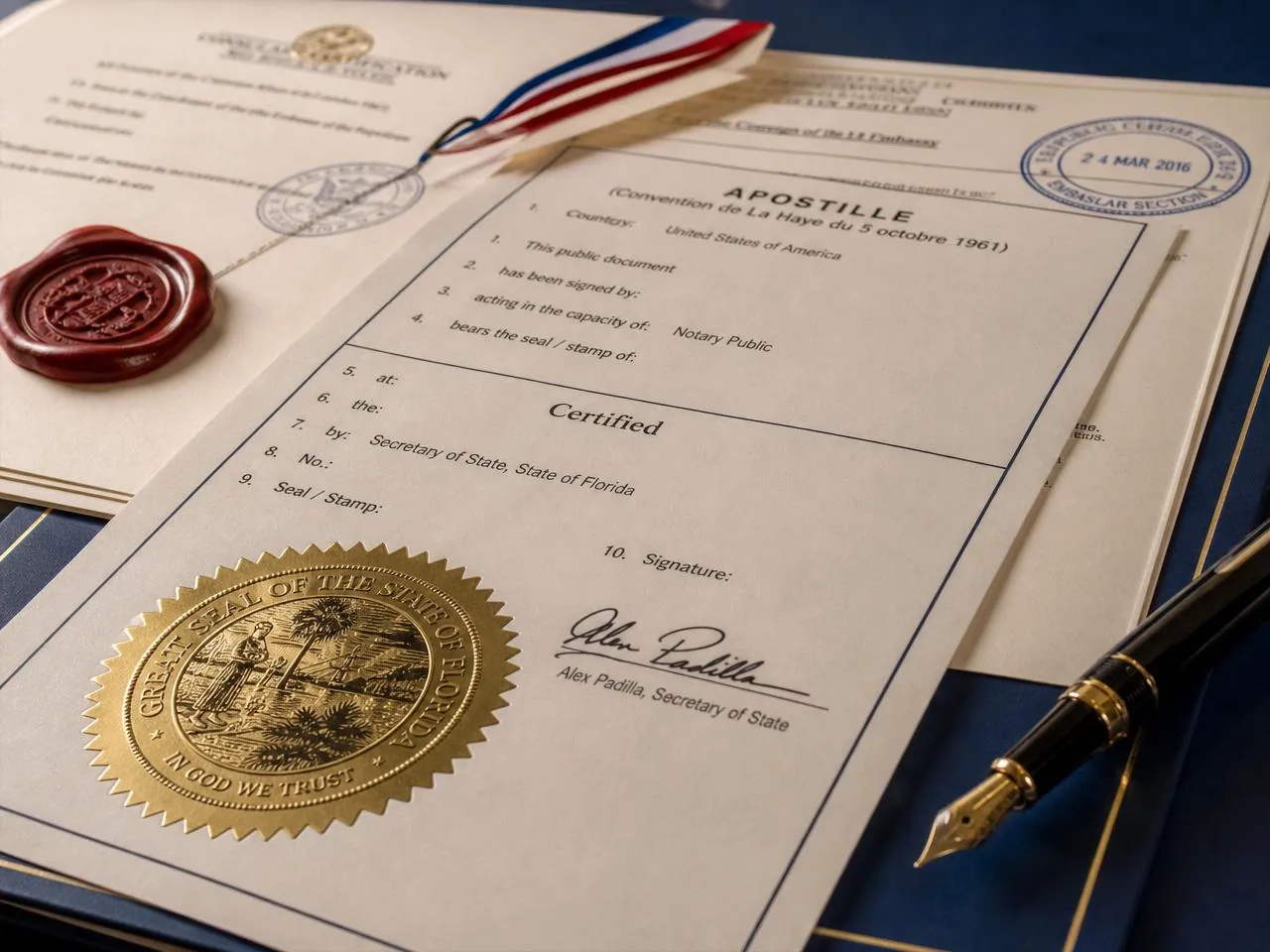
- Non-member states still require the full chain: Thai issuing authority, certified translation, Department of Consular Affairs, then the destination embassy in Bangkok.
- Many embassies accept documents only within a validity window (commonly three to six months from issue), so pull a fresh copy before you start rather than reusing an old one.
- Embassy requirements are set by the embassy, not by the Thai MFA — appointment rules, translation language and supporting ID differ per country and change without notice.
Want us to check your documents before you file? Call 080-5578887 or message LINE @NAATI
Official sources
This page is compiled from the notices and manuals published by the agencies below. Rules, fees and forms change — confirm with the receiving authority before you proceed.
- Department of Consular Affairs, MFA ThailandDocument legalisation (nitikorn) and passport servicesLast checked August 2026
- Department of Provincial AdministrationCivil and family registration, marriage and divorce recordsLast checked August 2026
- HCCH Apostille SectionList of contracting states and rules of the Apostille ConventionLast checked August 2026
Related services
One team handles the full chain — translation, notarisation, MFA legalisation and embassy attestation — so your document is accepted the first time.
Certification & legalisation
Translation
Personal records & immigration
Not sure which route your document needs?
Send a photo or scan and our staff will confirm the exact steps, supporting documents and realistic turnaround under the receiving authority's current rules.