Skip to content
โลโก้ NOTARY & APOSTILLE TRANSLATION INTERPRETERS (NAATI) CO., LTD.NAATINotary & Apostille

ทีมทนาย Notary Public ของเรา

ทนาย Notary Public 6 ท่าน ที่คุณวางใจได้

ทุกการรับรองดำเนินการโดยทนายความผู้ขึ้นทะเบียนเป็น 'ทนายความผู้ทำคำรับรองลายมือชื่อและเอกสาร' กับสภาทนายความในพระบรมราชูปถัมภ์ คลิกที่ใบอนุญาตเพื่อดูฉบับเต็ม

ภาพรวมทีมทนาย Notary Public ของ NAATI พร้อมวิววัดอรุณราชวราราม
Royal Thai Police · Criminal Records Division filing

Thai Police Clearance Certificate — applied for you

Fingerprinting, filing at the Criminal Records Division, certified translation and the Apostille or embassy legalisation your destination requires — handled end to end under a power of attorney, whether you are still in Thailand or already living abroad.

Quick answer

A Thai Police Clearance Certificate is a criminal-record check issued only by the Criminal Records Division of the Royal Thai Police in Bangkok. Anyone who has lived in Thailand and is applying for a visa, residence, licence or employment abroad is likely to need one. You do not have to attend in person: with fingerprints taken to the Division's standard and a power of attorney, we file, collect, translate and legalise the certificate for you.

Who needs a Thai police certificate

Australian visas & NAATI files

Partner, skilled and student visa applicants who spent 12 months or more in Thailand in the last 10 years must lodge a Thai police certificate with the Department of Home Affairs, together with a NAATI-certified English translation.

Canada, New Zealand, UK & Ireland

Express Entry, family sponsorship and long-stay visas each require a police certificate from every country of residence, usually issued within the last 6 months at the time of submission.

EU residence & work permits

Germany, France, Italy, Spain and the Netherlands require the certificate to carry an Apostille and a translation prepared by a translator their embassy or local court recognises.

Thai PR & naturalisation

Applications for Thai permanent residence and for Thai nationality both include a current police clearance certificate as part of the good-character assessment.

Professional licensing & employment

Teaching licences, healthcare registration, aviation roles, finance and offshore employers frequently require a Thai certificate for anyone who has lived here.

Adoption, marriage & guardianship abroad

Foreign family courts and adoption authorities routinely ask for a Thai police certificate, legalised for the receiving jurisdiction.

How the process runs

  1. 1. Eligibility and route check

    Send us your passport page and the requirement from the receiving authority. We confirm whether you need the Thai or English form, and whether the final document needs an Apostille or embassy legalisation.

  2. 2. Fingerprints to Royal Thai Police standard

    In Bangkok we arrange fingerprinting; from abroad we tell your local police or Thai embassy exactly what card and ink standard the Criminal Records Division accepts, so the file is not rejected on arrival.

  3. 3. Filing at the Criminal Records Division

    We lodge the complete file under your power of attorney and monitor it through the queue, so you never have to travel to Bangkok for the submission.

  4. 4. Certified translation

    Translation into English or the destination language. For Australia we issue a NAATI-certified translation; for Thai courts and ministries we can use a Ministry of Justice listed translator.

  5. 5. Apostille or embassy legalisation

    Hague member state: Apostille at the Department of Consular Affairs. Non-member state: MFA certification, then the destination embassy in Bangkok.

  6. 6. Delivery

    Scanned PDF as soon as the certificate is released, then courier of the originals anywhere in Thailand or abroad.

Frequently asked questions

Who issues a Thai Police Clearance Certificate?

Only the Criminal Records Division of the Royal Thai Police (กองทะเบียนประวัติอาชญากร, สำนักงานตำรวจแห่งชาติ) in Bangkok issues the certificate. Local police stations, embassies and agencies cannot issue one — an agent can only take your fingerprints to the required standard, lodge the application and collect the result on your behalf.

Do I need to be in Thailand to apply?

No. Applicants outside Thailand submit fingerprints taken by their local police force or by a Royal Thai Embassy/Consulate, together with passport copies, the completed application and a power of attorney appointing a representative in Bangkok to file and collect the certificate.

How long does it take?

Processing at the Criminal Records Division normally takes several weeks from the day a complete file is accepted; applications filed from overseas take longer because the fingerprint card travels by post. Timelines move with the Division's workload, so we confirm the current queue when you apply rather than promising a fixed date.

Does a foreigner who worked in Thailand need one?

Yes, if the receiving authority asks for it. Australia, Canada, New Zealand, the UK and most EU states require a police certificate from every country where you lived, typically for 6 or 12 months or more, and Thailand is no exception. The certificate is also required for Thai permanent residence and Thai naturalisation applications.

How long is the certificate valid?

The Royal Thai Police does not print an expiry date. Validity is set by whoever receives it: immigration authorities commonly accept a certificate issued within the last 3, 6 or 12 months. Check your destination's rule before you apply so the document does not go stale during processing.

Do I need a translation and legalisation as well?

Almost always. The certificate is issued in Thai (an English version is available on request in many cases). For use abroad you normally need a certified translation plus either an Apostille from the Department of Consular Affairs — for Hague Convention member states — or MFA certification followed by the destination embassy in Bangkok for non-member states.

What if I have a record in Thailand?

The certificate reports what the Criminal Records Division holds. A finalised conviction will appear; cases that were dismissed, withdrawn or ended in acquittal are treated differently and records can be corrected or expunged in defined circumstances. If you are unsure what will show, tell us before filing so the application is prepared with that in mind.

What documents do you need from me to start?

Passport bio page (and every Thai visa/entry stamp page), a Thai ID card or work permit if you hold one, proof of Thai address such as a house registration or rental contract, two recent photographs, your fingerprint card if you are abroad, and a signed power of attorney. We confirm the exact list for your case on LINE before anything is submitted.


Official sources

Free eligibility check

Tell us the country asking for the certificate and where you are now — we reply with the exact document list, the realistic timeline and the legalisation route.

Playbook: obtaining a Thai Police Clearance Certificate

A Thai Police Clearance Certificate is issued by the Police Clearance Service Centre of the Royal Thai Police and states the result of a criminal-records check in Thailand. The process has four core stages: preparing documents and stating the purpose of use, taking fingerprints, filing the application, and waiting for the records check. Documents intended for use abroad usually continue to the Department of Consular Affairs.

Documents to prepare

DocumentIssued byPreparation note
Passport or Thai ID card (original plus a copy)The applicantThe name filed must match the destination document letter for letter.
Evidence of stay in Thailand: visa pages or entry stampsImmigration BureauForeign applicants show the periods they were in the Kingdom.
Fingerprint formThe service centre, a police station, or an accepted authority abroadApplicants abroad may have prints taken by local police and send them in.
Document stating the purpose: employer, embassy or requesting authority letterThe receiving authorityThe stated purpose is printed on the certificate and must match what the receiving authority asked for.
House registration or proof of Thai addressif applicableDistrict office or landlord
Power of attorney if someone files on your behalfif applicableThe applicant

Step-by-step process

  1. 1

    Confirm which form the destination wantswe handle

    Establish what purpose the receiving authority requires, whether the certificate must be in English, and whether it must be certified further by the Department of Consular Affairs or an embassy. A wrong purpose means refiling the whole application.

  2. 2

    Collect documents and check name spellingyou prepare

    Gather the passport, evidence of stay, the purpose letter and photographs in the format the service centre requires. We cross-check name spelling against the passport and the destination paperwork before filing.

  3. 3

    Have fingerprints takenyou prepare

    Applicants in Thailand are printed at the service centre or a police station; those abroad are printed by local police and send the card in with the file. Unclear prints are a common cause of rejection.

  4. 4

    File the application and track the records checkwe handle

    We file the complete set at the service centre and track the status on your behalf. If the officer requests further evidence we tell you at once and supply it so the file keeps its place in the queue.

  5. 5

    Collect the certificate and certify further if neededwe handle

    Once issued, documents for use abroad go on to the Department of Consular Affairs and, where the legalisation route still applies, to the destination embassy.

Pitfalls — why files get rejected

  • Purpose does not match what the destination asked for

    The certificate prints the stated purpose — employment, visa, residence. If it is wrong the receiving authority usually refuses it and the application must be filed again.

  • Unclear prints or the wrong fingerprint form

    Smudged or doubled prints, or a form that did not come from a police authority, make the database check impossible and the whole set must be redone.

  • Name spelling differs from the passport

    Former names, titles or a different name order make the certificate unusable at the destination. Attach the change-of-name evidence with the application.

  • Filed too late for the destination's own window

    Many authorities accept only recently issued certificates. Count backwards from your filing date at the destination and start the process from there.

  • Forgetting the certification that follows

    The bare certificate is rarely enough abroad: it usually needs the Department of Consular Affairs and sometimes the destination embassy. Plan the full chain from the start.

Comparing the routes to a Thai police clearance certificate

OptionBest forAuthorityCaveat
File in person at the Bangkok service centreApplicants in Thailand who can travel to BangkokRoyal Thai PoliceRequires a queue slot and a complete file on the day.
File from abroad by sending documents and fingerprintsPeople who lived in Thailand but are now overseasRoyal Thai Police via an authorised representative in ThailandNeeds a power of attorney and prints certified by local police.
Let us run the whole file including consular certificationAnyone with a deadline at a foreign authorityPolice, Department of Consular Affairs, destination embassyTotal time depends on each authority's queue, so we quote a range, never a fixed date.

If you do it yourself

  • Book the slot and attend for fingerprinting yourself.
  • Interpret which purpose wording the destination needs.
  • Return in person if the officer asks for more evidence.
  • Deal separately with the consular department and the embassy.

If we handle it end to end

  • We confirm the purpose and format the destination requires before opening the file.
  • We arrange fingerprints, the power of attorney and the filing itself.
  • Translation and consular certification continue in the same workflow.
  • We track status and report progress on LINE throughout.

We advise, not just process paperwork

  • We advise before filing whether this set actually fits the destination's purpose.
  • If your case calls for a different document we say so rather than opening a file.
  • We sequence the work around your visa or employment deadline.
  • Fees are stated before work starts, and we never guarantee an authority's decision.

NOTARY & APOSTILLE TRANSLATION INTERPRETERS (NAATI) CO., LTD. — a team with more than 15 years of work in translation, document certification and filings with Thai authorities. We advise before any file is opened, and we never guarantee an authority's decision.

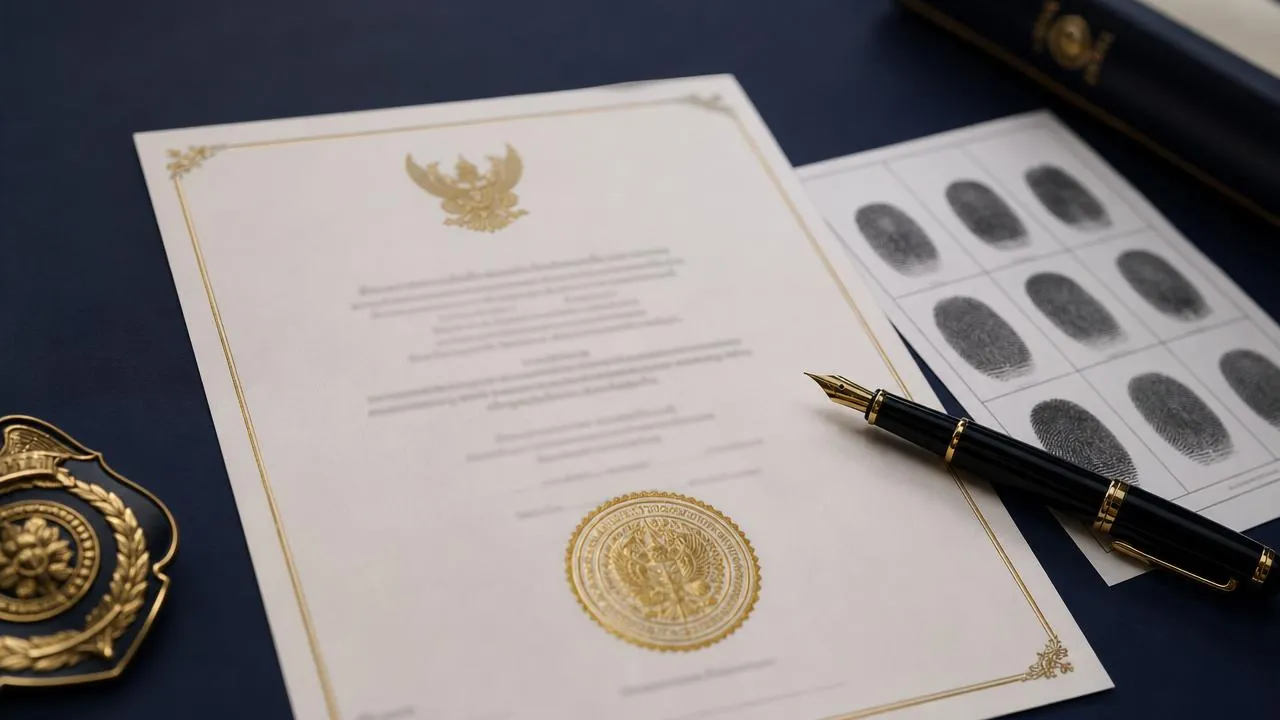
Thai police clearance certificate issued by the Royal Thai Police

Police clearance certificate: caveats

  • Fingerprints must be taken on the form the Royal Thai Police accepts; prints taken abroad need the correct card format and an accompanying ID copy.
  • Most immigration authorities treat a certificate as valid for three to six months from issue — request it in step with your visa timeline, not months ahead.
  • For overseas use the certificate normally needs a certified translation plus Department of Consular Affairs certification, and embassy legalisation for non-member states.

Want us to check your documents before you file? Call 080-5578887 or message LINE @NAATI

Official sources

This page is compiled from the notices and manuals published by the agencies below. Rules, fees and forms change — confirm with the receiving authority before you proceed.

Related services

One team handles the full chain — translation, notarisation, MFA legalisation and embassy attestation — so your document is accepted the first time.

Not sure which route your document needs?

Send a photo or scan and our staff will confirm the exact steps, supporting documents and realistic turnaround under the receiving authority's current rules.

โทรเลย080-5578887แอด LINE@NAATI