Remote employees
Employed by a company outside Thailand: contract, payslips, employer letter and financial evidence assembled in the order the mission's checklist expects.
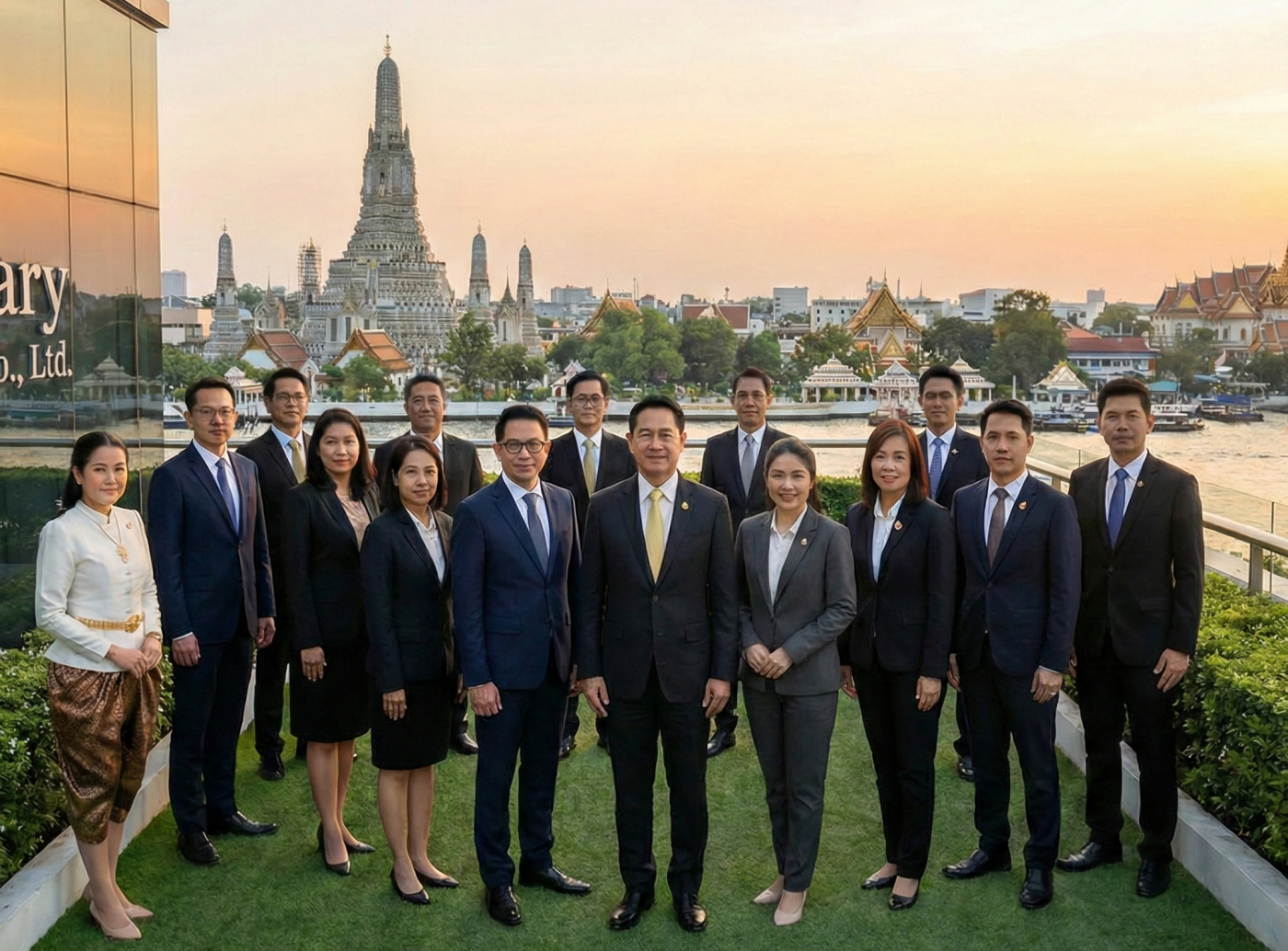
ทีมทนาย Notary Public ของเรา
ทุกการรับรองดำเนินการโดยทนายความผู้ขึ้นทะเบียนเป็น 'ทนายความผู้ทำคำรับรองลายมือชื่อและเอกสาร' กับสภาทนายความในพระบรมราชูปถัมภ์ คลิกที่ใบอนุญาตเพื่อดูฉบับเต็ม
A five-year multiple-entry visa for remote workers and soft-power visitors, with 180 days permitted per entry. We assess eligibility honestly, build the evidence pack, translate and legalise what needs it, and support your extension after arrival.

The DTV rewards a clean, consistent story: income earned outside Thailand, funds you can evidence in your own name, and a purpose that matches one of the recognised categories. Refusals usually come from documents that contradict each other — a contract naming a Thai client, statements that dip below the threshold, or an activity letter from a school the mission does not recognise. We audit the pack for those contradictions before it is submitted.
Employed by a company outside Thailand: contract, payslips, employer letter and financial evidence assembled in the order the mission's checklist expects.
Client contracts, invoices, overseas company registration and tax records, presented to show the income genuinely arises outside Thailand.
Gym enrolment letters and training schedules from recognised camps, with translation where the document is issued in Thai.
Course acceptance letters from recognised schools plus the supporting evidence missions ask for on soft-power applications.
Hospital appointment letters and treatment plans for extended care in Thailand, prepared as a soft-power DTV application.
Legalised and translated marriage and birth certificates for spouses and children under 20 applying as dependants.
We check your work arrangement, nationality and travel plan against the DTV criteria and tell you honestly whether DTV, LTR or Non-B fits better.
Requirements vary between Royal Thai Embassies. We pick the mission that fits your documents and residence, and prepare to its published checklist.
Bank statements, employment or client proof, accommodation and travel details, and family documents, all reviewed for consistency before upload.
Translation of any document not in English or Thai, with Apostille or embassy legalisation where the mission requires it.
Submission through the Thai e-Visa system, tracking, and prompt handling of any additional-document request from the consular officer.
180-day extension filing at Immigration, 90-day address reporting, and support if you later move to a Non-B or LTR route.
The DTV is a multiple-entry visa for people working remotely for employers or clients outside Thailand and for participants in soft-power activities such as Muay Thai, Thai cuisine courses or medical treatment. The core sequence is: choose the track that matches your real activity, assemble financial evidence plus track-specific supporting documents, file through the Thai e-Visa system at an accepting embassy, and await the decision. A DTV is not a Thai work permit.
| Document | Issued by | Preparation note |
|---|---|---|
| Passport (clear scan of the bio page) | The applicant | Remaining validity must comfortably cover the visa period applied for. |
| Financial evidence at the announced level | The applicant's bank | Use an account in the applicant's own name with a continuous statement history, not a single recent lump-sum deposit. |
| Remote-work evidence: employment contract, client contracts or a letter from the overseas employerif applicable | The overseas employer or client | Must show clearly that the income originates outside Thailand. |
| Soft-power evidence: acceptance letter from a Muay Thai gym, cooking school, or hospital appointmentif applicable | The Thai institution or hospital | — |
| Proof of accommodation or travel plan | Applicant, landlord or hotel | — |
| Relationship documents for dependants: marriage or birth certificateif applicable | The registrar in the issuing country | Foreign documents usually need certified translation and the legalisation the embassy requires. |
Pick the track that matches your real activitywe handle
The DTV splits into a remote-work (workation) track and a soft-power activity track, each with a different evidence set. Choosing the wrong track at the start is the most common cause of additional-document requests.
Prepare financial evidence that reads clearlyyou prepare
Provide a continuous statement history in the applicant's own name; if funds come from several sources add a short explanation, and translate any non-English document with certification.
Collect the track-specific supporting documentswe handle
The remote-work track relies on contracts and evidence of foreign-sourced income; the soft-power track relies on an acceptance letter from the Thai institution naming the course and its dates.
File through the e-Visa system at an accepting embassywe handle
DTV applications are filed from outside Thailand through the e-Visa system; each embassy may apply its own residence requirements and document details, so check that embassy's notice before uploading.
Receive the decision, enter, and plan the stayyou prepare
Once approved, check that the e-visa details match the passport, then plan each period of stay, any in-country extension, and the required reporting.
Assuming a DTV lets you work for a Thai company
The DTV covers work for overseas employers or clients. Taking on work for a Thai company requires a work permit and a different visa category.
Depositing a lump sum days before filing
A sudden balance with no clear origin usually triggers a request for more evidence; show continuous history instead.
An acceptance letter with too little detail
The letter should name the applicant, the course, its dates and the institution's contact details; a vague letter is weak support for the track.
Filing at an embassy that does not accept your residence
Many posts require the applicant to reside or hold status in their consular district; the wrong post leads to a technical refusal.
Not planning stay periods and reporting
Even with a long visa validity, each stay is capped; plan entries, exits and any extension in advance.
| Option | Best for | Authority | Caveat |
|---|---|---|---|
| DTV | Remote work for foreign clients, or soft-power activities | Thai embassies and consulates via e-Visa | Cannot work for a Thai company; must be filed from outside Thailand. |
| Non-B plus work permit | Employees of a Thailand-based employer | Department of Employment + Immigration | Requires an employer meeting capital and Thai-staff ratio criteria. |
| LTR | High-income or high-asset applicants and targeted-industry professionals | Board of Investment | Stricter qualifying criteria and more detailed financial documentation. |
NOTARY & APOSTILLE TRANSLATION INTERPRETERS (NAATI) CO., LTD. — a team with more than 15 years of work in translation, document certification and filings with Thai authorities. We advise before any file is opened, and we never guarantee an authority's decision.
The DTV is a five-year multiple-entry visa introduced by the Ministry of Foreign Affairs for remote workers employed or contracted outside Thailand and for people coming for recognised 'soft power' activities such as Muay Thai training, Thai cooking courses, medical treatment and cultural study. Each entry grants a stay of up to 180 days.
Each 180-day entry can be extended once at an Immigration office for a further period, subject to the officer's discretion and the supporting documents you present. Many holders instead leave and re-enter, which resets the 180-day permission for as long as the visa remains valid.
No. The DTV covers work performed for employers or clients outside Thailand. Working for a Thai employer, or performing work in Thailand that requires a permit, needs a Non-Immigrant B visa and a work permit instead. We will tell you plainly if your situation is a Non-B case rather than a DTV case.
Applicants must show funds of at least 500,000 baht or the equivalent, normally through bank statements covering recent months in the applicant's own name. Embassies differ on how many months and whether they accept joint accounts or investment statements, so the pack is prepared for the specific mission you apply to.
An employment contract with a foreign employer plus recent payslips, or for freelancers a portfolio of client contracts and invoices, company registration abroad, and evidence that the income arises outside Thailand. Documents in other languages typically need certified translation; some missions also want them legalised.
Yes. Spouses and children under 20 can apply as dependants with the marriage certificate or birth certificates, which must generally be legalised and translated. Their permitted stay follows the principal applicant's.
The DTV is applied for at a Royal Thai Embassy or Consulate outside Thailand, in most cases through the e-Visa system. It cannot normally be converted from inside Thailand, so plan the application around a trip abroad.
No. The DTV is a long-stay visitor route: it does not count toward the continuous permitted-stay history used for Thai permanent residence, which is built on Non-Immigrant status with work permits and tax filings. If residence is your goal we will map the Non-B or LTR route instead.
One team handles the full chain — translation, notarisation, MFA legalisation and embassy attestation — so your document is accepted the first time.
Send a photo or scan and our staff will confirm the exact steps, supporting documents and realistic turnaround under the receiving authority's current rules.
Tell us your nationality, how you earn, and where you are applying from. We reply with a clear yes/no on DTV eligibility, the document list and the translation or legalisation you will need.